Sensory profile
The agreed aroma and taste direction—fresh, roasted, creamy, sweet, gelato-style or confectionery—is more precise than the word pistachio alone.
 NOURISHING WHAT MATTERS
Learn what pistachio flavor is, how commercial flavoring is developed and used, and how to specify liquid pistachio profiles for bakery, confectionery, dairy, beverages and frozen desserts.
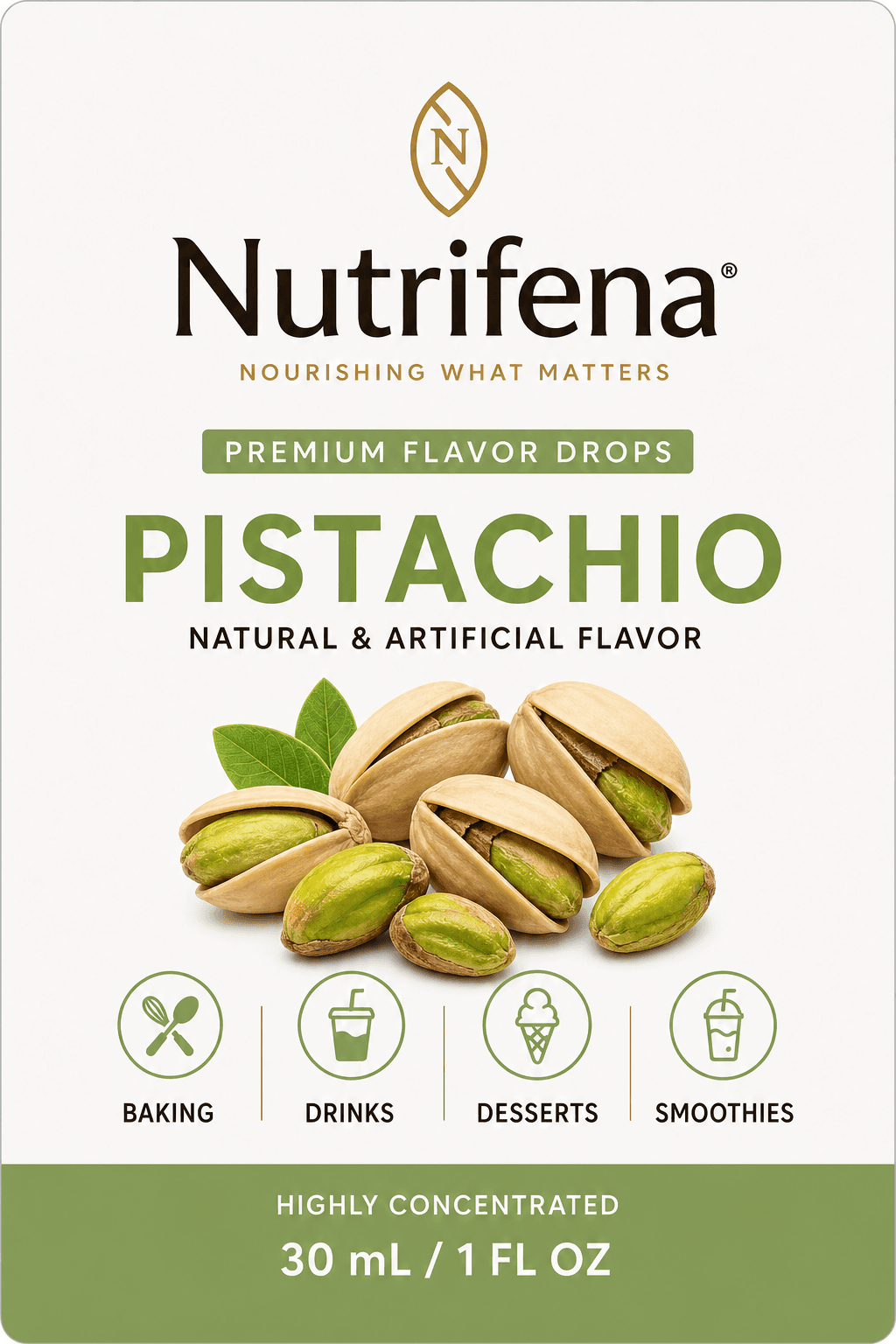 Nutrifena Flavor Drops · 30 mLPistachioView all five flavors
Pistachio flavor is a concentrated sensory preparation designed to create, reinforce or standardize a selected pistachio character in a finished food or beverage. Profiles can emphasize raw or fresh nut, roasted, toasted, creamy, sweet, marzipan-like, gelato-style or confectionery notes. The name describes the sensory direction; it does not establish whether the formula contains pistachio, another tree nut, a particular carrier or any specific flavoring substance.
A useful commercial choice depends on the target reference, product base, fat and water phases, sweetness, heat process, use level, package, shelf life, flavor classification and destination market. Nutrifena currently links one specific Nature-Identical Pistachio Flavor SKU with published commercial terms; its exact composition, allergen status, carrier, solubility and label treatment must be confirmed from current product documentation before use.
Pistachio flavor is not proof that a product contains pistachio, is pistachio-free, is allergen-free, is natural or may use a particular label declaration. Confirm the exact SKU composition, carrier, source, classification, allergen statement and destination-market requirements. If pistachio or pistachio-derived protein is present, applicable tree-nut allergen controls and declarations must be addressed. This page does not provide a universal dosage or finished formula.
Pistachio flavor is an ingredient system selected to make a finished product smell and taste more like an agreed pistachio reference.
Flavor perception combines aroma, taste and mouthfeel. A pistachio concept may need a green, fresh-nut impression; a deeper roasted note; a sweet gelato profile; or a creamy confectionery direction. A flavor preparation can contribute selected aromatic and taste impressions, but it does not automatically supply the fat, protein, solids, color, texture or visible pieces contributed by real pistachio ingredients.
Commercial flavoring is concentrated and is normally added at a controlled use level to another food or beverage. The supplier may design the profile for a particular matrix or broad application family. Carrier, strength, solubility or dispersibility, flavor classification and storage are attributes of the exact grade. Two products named pistachio flavor can differ materially in profile and performance.
The page at this URL addresses the broad sourcing and formulation intent behind searches for pistachio flavor and pistachio flavoring. It helps a developer understand terminology, application variables and purchasing questions. The linked product page represents the concrete Nutrifena SKU and retains its verified packaging, SKU and current offers, preventing the category guide from competing with the transactional product page.
The agreed aroma and taste direction—fresh, roasted, creamy, sweet, gelato-style or confectionery—is more precise than the word pistachio alone.
A concentrated commercial ingredient containing a supplier-defined flavor system and carrier. Exact composition and classification require documentation.
Determined from supplier guidance and application trials. More flavor is not always better and can create imbalance or emphasize unwanted notes.
Fat, protein, sugar, cocoa, acids, temperature and serving conditions change how pistachio character is released and perceived.
Heat, mixing, pressure, aeration, freezing and storage can reduce, shift or redistribute aroma. Test the real production sequence.
A flavor name does not establish nut content, allergen status, natural status, color contribution or finished-product naming.
A supplier can only match a target efficiently when the buyer describes the intended pistachio experience in context.
Fresh or green pistachio profiles may emphasize delicate nut character and a lighter aromatic top note. Roasted profiles may emphasize toasted, browned or deeper nutty impressions. Creamy pistachio often includes dairy-like or vanilla-supporting notes, while confectionery profiles may be sweeter and more stylized. None of these descriptions is a universal formula; they are directions that should be anchored to a physical reference.
The surrounding formula changes the target. Milk fat, coconut fat, cocoa butter or another lipid can hold and release aroma differently. Sugar and high-intensity sweeteners change perceived intensity and aftertaste. Vanilla, almond-like, caramel or roasted notes can complement pistachio but may also dominate it. Salt can increase contrast, while acids can move the concept away from a classic creamy profile.
Color strongly influences expectation but should remain a separate formulation decision. Consumers may associate pistachio with pale green, yellow-green, beige or the natural color of a nut-containing base. A green color can make a weak flavor seem more recognizable during early tasting, but it does not create pistachio aroma and does not prove pistachio content. Evaluate flavor both with and without the intended color to understand each ingredient’s role.
A lighter, delicate direction. Define the reference and acceptable green, raw-nut or subtle sweet notes without assuming actual nut content.
Emphasizes toasted or browned character. Control bitterness, burnt notes and interaction with cocoa, coffee or baked flavors.
Designed around a rounded dairy or dessert impression. Fat, protein, vanilla and sweetness influence the final balance.
A finished-product reference combining nut character, sweetness, cold serving and creamy mouthfeel. Flavor alone does not provide the complete system.
A sweeter, recognizable profile for fillings, candy or coatings. It may be intentionally stylized rather than a literal roasted-nut match.
Combines pistachio direction with chocolate, vanilla, rose, cardamom, citrus or another note. Each supporting flavor needs a defined role.
These materials may appear in the same product, but they contribute different composition, texture, allergen and label consequences.
Whole or chopped pistachios provide visible pieces, fat, protein, fiber, color and characteristic flavor. Pistachio paste or butter is a ground nut ingredient that contributes nut solids and fat as well as sensory character. Their natural variation, oxidation, particle size, viscosity and cost must be managed. If they contain pistachio protein, the finished product must address applicable tree-nut allergen controls and labeling.
A pistachio flavor preparation is selected primarily for sensory impact. Depending on its exact composition, it may or may not contain material derived from pistachio. It normally cannot replace the body, nutrition or visual identity of a nut paste. A manufacturer may use flavor to reinforce a real-pistachio base, restore aroma lost through heating or storage, or develop a profile in a formulation where the final identity and allergen status are separately established.
Pistachio syrup is usually a finished or semi-finished sweet liquid containing sugar or another sweetener, water, flavor and potentially color, preservatives or other ingredients. It is not the same as concentrated industrial flavoring. Pistachio extract is also an ambiguous commercial expression: it may refer to a nut-derived extract, a flavor extract or another supplier-defined product. Request the full specification instead of treating the word extract as proof of source or strength.
Supplies recognizable nut pieces and composition. Requires oxidation, particle, microbial, foreign-material and tree-nut allergen controls.
Ground nut ingredient contributing fat, solids, color and texture. It changes rheology and nutrition as well as flavor.
Concentrated sensory preparation. Source, composition, carrier, allergen status and classification are exact-product questions.
An incomplete commercial description. Confirm what was extracted, from what source, by which process and for what intended use.
A sweetened liquid system intended for dosing or direct use. It usually contributes substantial water and sweetener unlike industrial flavor.
Creates the intended visual cue but contributes no guaranteed pistachio aroma, nut solids or allergen identity.
Allergen status must come from the exact composition, supplier statement and manufacturing controls—not from the sensory profile name.
Pistachio is a tree nut in U.S. major-allergen labeling. FDA explains that when a tree-nut ingredient is present, the specific type of tree nut must be declared in the required manner. A formulation containing pistachio pieces, paste or protein therefore has clear allergen implications. The facility must also manage cross-contact through receiving, storage, weighing, scheduling, cleaning, rework, label control and verification.
A flavor named pistachio is not automatically made from pistachio, and it is not automatically free from pistachio. Flavor formulas can contain multiple components and carriers. The buyer should obtain a current allergen statement and sufficient composition information for the exact SKU, then confirm whether any component contains protein derived from pistachio or another major allergen. A salesperson’s verbal description or the phrase nature-identical is not adequate evidence.
FDA’s allergen policy makes clear that allergenic ingredients cannot simply disappear behind a collective flavor declaration when disclosure is required. Advisory statements such as may contain are not a substitute for good manufacturing practices. Final label wording and controls should be reviewed by the responsible quality and regulatory teams for the actual product, supplier, facility and destination.
Request the current allergen declaration for the supplier SKU and confirm its scope, revision and relationship to the manufacturing site.
Review flavor components and carrier or solvent information to the level needed for allergen, label and customer-restriction decisions.
If present from an ingredient, applicable tree-nut declaration and facility controls must be addressed for the finished product.
Milk, soy or other allergen considerations may arise from carriers or supporting ingredients; never restrict review to the profile name.
Supplier and receiving-facility controls must address unintended allergen presence according to risk, equipment and production practices.
Reconcile the approved formula, supplier documents and printed package before release and whenever a flavor or supplier changes.
Pistachio is a sensory name; the legal flavor declaration follows the exact ingredients and destination-market rules.
In the United States, 21 CFR 101.22 provides definitions and labeling rules for natural and artificial flavor. A profile that tastes like pistachio is not automatically a U.S. natural pistachio flavor. The supplier must support classification based on the exact flavoring materials and manufacturing basis, and the finished manufacturer must determine the appropriate declaration in the context of the food.
Nature-identical is used commercially and in some regulatory systems to describe selected flavoring substances corresponding to substances identified in nature but produced through another route. It should not be assumed to map directly onto a U.S. natural flavor declaration. Nutrifena preserves the supplier product name Nature-Identical Pistachio Flavor while requiring destination-specific label review.
Natural, Organic, non-GMO, vegan, kosher, halal and allergen-free answer different questions. No one claim proves another. Organic status requires product- and supply-chain-specific certification; vegan depends on source and complete composition; religious certifications require current scope; allergen conclusions require exact evidence. The category page makes no such claim for the linked SKU unless it appears in verified product documentation.
A U.S. regulatory classification that must be supported under applicable definitions and conditions; it cannot be inferred from a pistachio profile.
A classification based on flavoring substances and intended characterizing flavor under applicable rules, not a judgment about quality.
A supplier or market term that requires jurisdiction-specific interpretation and should not be converted automatically into U.S. natural-label language.
Requires certification for the exact commercial product and supply chain. Neither pistachio naming nor natural classification proves Organic status.
The sensory identity expected by the consumer. Finished-product naming and any source implications require label review beyond ingredient classification.
Classification statement, specification, composition, allergen information and destination-market review should align before artwork approval.
The base formula and serving conditions influence aroma release, intensity and the supporting profile needed.
Ice cream and gelato are cold, fat- and protein-containing systems in which low serving temperature can suppress aroma. A flavor screened at room temperature may appear weaker when frozen. Pasteurization can reduce volatile top notes, while aging, freezing and overrun change distribution and perception. Evaluate the flavor after the complete process and at the intended serving temperature, not only in the liquid mix.
Bakery and fillings present different exposures. A cake or cookie flavor may lose volatile notes during baking or shift alongside browning, butter, vanilla and sugar. A post-bake cream, icing or filling receives less oven heat but may contain fat, low water activity or emulsified phases that alter release. The same pistachio flavor and dosage should not be copied automatically between baked dough and filling.
Chocolate, confectionery and beverages create further contrasts. Cocoa and roasted notes can mask delicate pistachio character; high sugar and fat can delay release; acidic beverages may not fit a classic creamy profile and can challenge carrier compatibility. Protein drinks and plant-based bases can introduce beany, bitter or mineral notes that require a more robust flavor architecture. Each matrix needs its own use-level series and shelf-life trial.
Test after pasteurization, aging, freezing and storage at serving temperature. Balance fat, protein, sweetness and color.
Evaluate thermal loss, browning, crumb aroma and addition point. A heat-exposed batter may need a different approach from icing.
Consider fat phase, water activity, emulsification, storage and interaction with vanilla, dairy, chocolate or fruit notes.
Assess fat compatibility, cocoa masking, processing temperature, release during eating and protection from oxidation.
Confirm water or emulsion compatibility, clarity or opacity, pH, heat process, ring formation, sediment and package life.
Test against proteins, minerals, vitamins and sweeteners that can suppress aroma or add bitterness and aftertaste.
Flavor approval must cover the production process and packaged life, not just a fresh bench sample.
Volatile aroma compounds can be lost during open mixing, heating, baking, concentration or drying. Total exposure depends on temperature, time, pressure, airflow and product geometry. Adding a flavor later may reduce heat loss in some processes, but the addition point must remain compatible with food safety, mixing uniformity and equipment. A supplier’s heat-stable description still needs application-specific validation.
Fat can retain hydrophobic aroma compounds and change when they are released during eating. Water-based systems can expose poor dispersion, surface rings or container adsorption. Proteins and starches can bind or slow release, while cocoa, coffee, vanilla, rose or cardamom notes can mask or reshape the profile. The carrier system should fit both the flavor chemistry and the manufacturing phase where it is added.
Oxygen, light and package transmission can change aroma through shelf life. Frozen storage slows some changes but does not prevent flavor imbalance or package odor transfer. Dry mixes need moisture and aroma barriers; liquid products require package compatibility and microbial controls appropriate to the complete formula. Real-time sensory work in the finished package should define whether the pistachio character remains acceptable at the end of life.
Compare early and late addition where process rules allow, then verify uniformity, retention and operational control.
Replicate actual temperature, hold, pressure, airflow and cooling rather than testing only one peak temperature.
Evaluate how aroma distributes between fat and water phases and how that affects immediate and lingering perception.
Long mixing, uncovered holds and large surface area can increase volatile loss before packaging.
Test aroma retention, oxygen exposure, seal integrity and odor transfer using the intended packaging system.
Retain an approved fresh standard and define acceptable change in intensity, balance, off-notes and overall pistachio identity.
A flavor house builds and standardizes a sensory system; the exact formula and manufacturing route remain supplier specific.
Development begins with a sensory brief and regulatory market. Flavorists analyze the target’s opening aroma, roasted or green notes, creamy middle, sweetness association and finish, then select permitted flavoring materials capable of building that profile. The work may use analytical information, sensory references and repeated application trials, but no single molecule represents the entire experience of pistachio.
The selected flavoring components are combined in an appropriate carrier or delivery system. For this category, Nutrifena presents the available form as Liquid, consistent with the linked flavor product family. Carrier identity, concentration, solubility, allergens and storage are not inferred; they remain supplier-specification facts. The batch is mixed under controlled conditions, standardized and tested against sensory and analytical criteria established by the manufacturer.
A released flavor concentrate is not automatically approved for every finished product. The food manufacturer still needs incoming qualification, controlled storage and dosing, application testing, allergen and regulatory review, label approval and shelf-life validation. Supplier guidance can establish a starting range, while the responsible product team determines the final use level through controlled trials.
Specify fresh, roasted, creamy, gelato or confectionery direction with a physical sample and target application.
Select permitted materials that create the required aroma and taste balance under destination-market constraints.
Match liquid delivery, concentration and compatibility to manufacturing and storage requirements.
Control weighing, order of addition, mixing and batch adjustment according to the flavor manufacturer’s process.
Compare sensory profile and applicable quality attributes with the supplier specification and retained reference.
The customer tests use level, process survival, label, package and shelf life in the complete commercial application.
Controlled dose-response trials reveal profile balance and prevent a strong sample from being mistaken for the correct sample.
Prepare an unflavored control and several coded flavor levels using the same batch of base. Weigh the flavor accurately instead of counting uncontrolled drops. Keep mixing time, temperature, hold and serving conditions constant. If the flavor needs pre-dilution, record the diluent and ratio. Small use levels can create significant variation when bench equipment and scales are not appropriate.
Evaluate more than overall liking. Record fresh or roasted pistachio identity, creaminess, sweetness association, intensity, onset, finish and unwanted almond-like, cherry-like, bitter, perfumery, solvent or burnt notes. The exact descriptors should come from the project team and reference. Color and brand cues can bias results, so blind evaluation is useful during technical screening.
Repeat the best candidates after processing and at several shelf-life points. A flavor that begins bright may fade, while a restrained level may remain more balanced. Compare the same samples at actual serving temperature—especially frozen products. Once approved, retain the formula, flavor SKU and lot, use level, preparation protocol, sensory standard and acceptable tolerance for scale-up and change control.
Reveals the base’s own nutty, dairy, beany, cocoa, vanilla or bitter notes and provides a benchmark for every trial.
Shows how intensity and profile change with dose. Avoid approving from one supplier-recommended point only.
Reduce expectation bias from product names, colors and dose order during technical sensory comparison.
Run shortlisted levels through production-relevant heat, shear, freezing, baking or storage before final approval.
Evaluate frozen, chilled, ambient or heated as consumed because temperature changes aroma release.
Retain the approved reference, test method and tolerance so procurement or supplier changes can be evaluated consistently.
A complete RFQ identifies the sensory target, application, classification and commercial requirement before asking for price.
Describe the finished product, target pistachio profile and physical reference. State whether the concept is ice cream, gelato, bakery, filling, confectionery, beverage, dry mix or nutrition product. Include fat and water phases, proteins, cocoa, sweeteners, acids, color, process, addition point, serving temperature, package and intended shelf life. These details help determine whether an available flavor belongs in the screening set.
Provide required classification and destination market. Ask for the exact current specification, flavor-classification statement, composition or ingredient statement, allergen status, carrier, solubility or dispersion, storage, shelf life and available regulatory documents. State explicitly whether pistachio-derived material is required, prohibited or acceptable and whether vegan, Organic, kosher, halal, non-GMO or other evidence is needed.
For the linked Nutrifena Nature-Identical Pistachio Flavor, the product page provides the public SKU, 17 kg commercial packaging and current offer tiers. A quote should still confirm availability, batch, destination, freight, documentation and final commercial terms. If the existing profile does not match the application, send the reference, volume and project scope for a sourcing review rather than assuming the SKU can be reformulated without evaluation.
Specify fresh, roasted, creamy, gelato or confectionery pistachio and provide a physical benchmark where possible.
List fats, proteins, sugars, sweeteners, cocoa, acids, colors and other components likely to alter perception or compatibility.
Provide mixing, heat, bake, pasteurization, freezing, drying, addition point and hold conditions.
State market, required flavor declaration, pistachio-content position, allergens and supported certification needs.
Include sample quantity, initial order, annual demand, destination, package preference and launch schedule.
Request specification, COA, allergen statement, composition, classification, origin, SDS and applicable certification evidence.
The workflow separates sensory profile, flavor qualification, allergen review, processing and commercial approval.
Set application, consumer, serving condition, pistachio identity, sweetness, texture, color, package, shelf life and destination market.
Choose a physical benchmark and describe fresh, roasted, creamy, green, gelato or confectionery notes plus unacceptable characteristics.
Establish whether nuts, paste or other pistachio-derived ingredients are required, prohibited or optional and account for composition and allergens.
Review classification, carrier, form, solubility, allergen statement, application guidance, storage and supplier documentation before trials.
Compare an unflavored control and multiple weighed levels in the true base using coded samples and fixed preparation conditions.
Adjust sweetness, salt, vanilla, dairy or plant notes, cocoa, color and texture without using flavor intensity to hide unresolved base defects.
Test the candidates through actual heat, mixing, baking, freezing, pressure, addition point, filling and cooling conditions.
Reconcile exact composition, supplier statements, facility controls, flavor classification and finished-product claims for the market.
Evaluate aroma retention, off-notes, color, texture and overall identity in the intended package and storage conditions.
Lock the SKU, use level, manufacturing instructions, specifications, commercial terms, incoming controls and change-management requirements.
The right material depends on whether the formula needs aroma, nut solids, fat, texture, visual identity or a ready-to-dose sweet system.
| Pistachio-related material | Primary contribution | Key qualification questions |
|---|---|---|
| Liquid pistachio flavor | Concentrated sensory character with supplier-specific carrier, strength, classification and composition. | Profile, use level, water or fat compatibility, heat, allergen status, classification, package, storage and shelf life. |
| Whole or chopped pistachios | Visible nut pieces plus pistachio fat, protein, solids, color, texture and natural sensory variation. | Tree-nut allergens, size, roast, defects, oxidation, moisture, microbial controls, foreign material, package and supply. |
| Pistachio paste or butter | Ground pistachio contributing fat, protein, solids, viscosity, color and flavor. | Nut percentage, roast, particle size, oil separation, oxidation, viscosity, allergens, storage and label identity. |
| Pistachio extract | Ambiguous term that may describe a nut-derived extract, flavor extract or another supplier-defined preparation. | Source, extraction, composition, carrier, strength, allergens, intended use, classification and evidence. |
| Pistachio syrup | Sweet liquid system commonly combining water, sweetener, flavor and potentially color or preservatives. | Dilution, sugar and solids, flavor source, allergens, pH, microbial control, package, opened life and finished-product role. |
| Pistachio cream or filling | Semi-finished product combining fat, sugar, nut or flavor components and texture system. | Complete formula, nut content, allergens, viscosity, water activity, process, package and intended use. |
| Pistachio color system | Green, yellow-green or beige visual cue without guaranteed pistachio aroma or nut composition. | Color identity, permitted use, pH, heat, light, label declaration, package and match with the flavor profile. |
Final performance depends on the exact grade, complete formulation and manufacturing process.
Liquid
Fresh, roasted, creamy, gelato or confectionery profile
Exact flavor classification for the destination market
Complete composition and pistachio/tree-nut allergen status
Water or fat compatibility and carrier system
Heat, pH, mixing and addition point
Target use level and sensory reference
Package, storage and finished shelf life
Specification, COA and regulatory documentation
Open each product page for its available specification, packaging, documentation and current commercial information.
The name alone does not answer that. Review the exact composition and allergen statement.
It is a concentrated flavor preparation designed to create, reinforce or standardize an agreed pistachio sensory profile in another food or beverage. Exact carrier, composition, strength and classification depend on the supplier SKU.
No. Pistachio paste is a ground nut ingredient contributing fat, protein, solids, texture and allergens. Flavoring is selected primarily for sensory impact and does not automatically supply those properties.
Not necessarily. Pistachio extract is an ambiguous term that must be defined by source, extraction and composition. A flavoring is a supplier-defined sensory preparation and may or may not contain pistachio-derived material.
The name alone cannot determine that. Obtain the exact flavor’s composition and current allergen statement. If pistachio-derived protein or another major allergen is present, applicable controls and label declarations must be addressed.
Only when the exact composition and destination-market rules support that classification. A pistachio sensory profile or nature-identical product name does not automatically establish a U.S. natural flavor declaration.
It is a supplier or market classification describing the flavor product. Terminology varies by jurisdiction and should not be converted automatically into natural, artificial or finished-label language without documentation and regulatory review.
A suitable grade may be evaluated, but test it after pasteurization, aging, freezing and storage at serving temperature. Fat, protein, sweetness and cold aroma release affect the final use level.
Potentially. Validate the exact grade through the intended mixing and baking process because heat, browning, fat and package storage can change flavor retention.
Potentially, but carrier compatibility, water or fat dispersion, pH, heat, clarity or opacity, sediment, ring formation and shelf life must be tested in the complete drink.
Not necessarily. Flavor and color are separate ingredient functions. Any green or pistachio-associated color should be selected, declared and validated independently.
The category presents the available flavor form as Liquid. Exact carrier, concentration, solubility and handling remain subject to the current supplier specification.
There is no universal dosage. Begin with guidance for the exact SKU and compare multiple accurately weighed levels in the real formula after processing and through shelf life.
A flavor supplier defines a sensory and regulatory target, builds an accord from permitted flavoring materials, selects a carrier, manufactures and standardizes the batch, tests it against specification and evaluates it in applications. Exact formulas and processes are proprietary and supplier specific.
First identify whether intensity is being suppressed by fat, protein, sugar, temperature, heat loss, package or competing notes. Test controlled flavor levels and addition points instead of increasing dosage blindly.
Nutrifena links Nature-Identical Pistachio Flavor, SKU NTF-000359, in a 17 kg commercial package. Current price tiers and purchasing details remain on the specific product page.
Request the current specification, lot COA format, composition or ingredient statement, allergen statement, flavor-classification statement, carrier and solubility information, SDS, origin, storage, shelf life and applicable certifications.
Provide sensory reference, application, complete base, process, addition point, serving temperature, classification, allergen and composition restrictions, package, shelf life, annual volume, destination and required documents.
Current U.S. definitions and labeling provisions for spices, flavorings, colorings and chemical preservatives.
Open official resourceOfficial overview of major food-allergen labeling, including the requirement to identify the specific type of tree nut when applicable.
Open official resourceCurrent FDA questions and answers addressing allergen labeling, tree nuts, ingredients and manufacturing situations.
Open official resourceOfficial overview of flavors and other ingredient functions in beverages, candies, ice cream, bakery mixes, fillings and related foods.
Open official resourceSend the application, specification, annual volume and destination. Nutrifena will evaluate available products, documentation and commercial terms.