Aroma
Vanilla perception can include creamy, sweet, floral, woody, balsamic, smoky, bean-like or confectionery notes in different balances.
 NOURISHING WHAT MATTERS
Understand vanilla flavor, vanilla extract and liquid flavor systems for bakery, beverages, dairy, frozen desserts and confectionery.
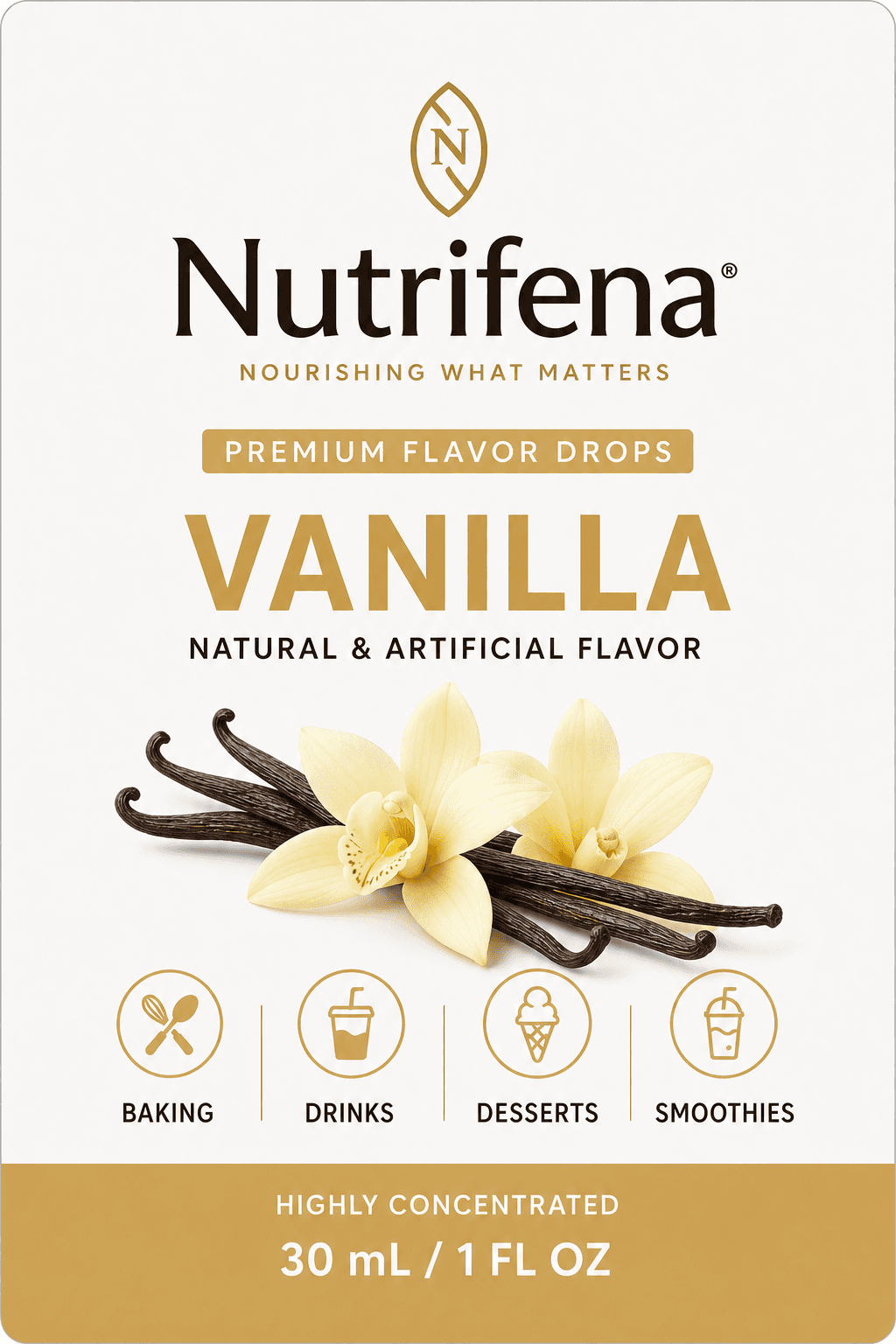 Nutrifena Flavor Drops · 30 mLVanillaView all five flavors
Vanilla flavor is a broad sourcing term for ingredients used to create, reinforce or standardize a vanilla sensory profile in a finished food or beverage. A profile may be creamy, sweet, floral, woody, bean-like, custard-like or designed to round cocoa, coffee, dairy and fruit systems. The name alone does not establish whether the product is vanilla extract, a natural flavor, an artificial flavor or another supplier-defined preparation.
Vanilla extract and compounded vanilla flavors are not automatically interchangeable. They can differ in source, composition, alcohol, carrier, strength, color, aroma complexity, processing behavior and legal identity. Manufacturers should select by the finished application and approve the exact supplier SKU, documentation and label treatment for every destination market.
Vanilla flavor is not one standardized commercial formula. Vanilla extract has a specific U.S. standard of identity, while other vanilla-named flavor preparations may have different composition and labeling requirements. Classification, source, carrier, alcohol, strength, use level and regulatory suitability must be confirmed for the exact SKU and destination market.
Vanilla flavor is an ingredient system selected to give a finished product a defined vanilla aroma and taste. It is a category of possible solutions—not one universal recipe.
People often use vanilla, vanilla flavoring and vanilla extract as if they were the same material. In commercial formulation, that shortcut creates mistakes. A bottle may be a standardized vanilla extract made from vanilla beans, a compounded natural flavor, an artificial vanilla flavor or another preparation with a supplier-specific carrier and strength. The specification and regulatory documents identify the product; its brown or clear appearance does not.
Vanillin is a major contributor to familiar vanilla character, but natural cured vanilla beans and their extracts contain a broader chemical and sensory profile. Primary research on Vanilla planifolia describes how green pods contain aroma precursors and how curing changes them, including the release and formation of vanillin and other compounds. A compounded flavor can instead be designed around selected aroma materials to meet a particular profile, performance and cost objective.
The target is rarely simply more vanilla. A developer may need a light floral vanilla for a beverage, a creamy custard direction for dairy, a strong bake-stable profile for cookies, or a woody bean-like character for premium ice cream. The correct flavor must be evaluated in the complete product after processing and through the intended shelf life.
Vanilla perception can include creamy, sweet, floral, woody, balsamic, smoky, bean-like or confectionery notes in different balances.
Vanilla can round bitterness and acidity or reinforce perceived sweetness, but it does not replace the formula's sweetener, cocoa, coffee or dairy system.
Vanillin is an important vanilla aroma compound, but its presence or intensity alone does not define source, legal classification or the complete sensory profile.
Bean-like, creamy, custard, bakery and candy-style vanilla are different briefs. An approved sensory reference makes the target measurable.
Supplier grades with similar names can have different concentration and recommended use levels. Compare controlled dosages in the final matrix.
Extract, natural flavor and artificial flavor can solve related sensory problems but have different composition and documentation requirements.
The distinction matters for purchasing, formulation, ingredient declarations and claims.
In the United States, 21 CFR 169.175 defines vanilla extract as a solution in aqueous ethyl alcohol of flavor and aroma principles extractable from vanilla beans, with at least 35 percent ethyl alcohol by volume and at least the prescribed vanilla constituent. The rule also identifies permitted optional ingredients. A supplier product sold as vanilla extract should be evaluated against that standard and its declared fold strength.
The U.S. standard called vanilla flavoring in 21 CFR 169.177 is tied to the vanilla-extract standard but contains less than 35 percent ethyl alcohol by volume. That narrow regulatory identity should not be confused with every compounded product that buyers casually call vanilla flavor. Natural and artificial flavor preparations are also subject to the applicable definitions and label rules in 21 CFR 101.22.
Vanillin is a named chemical compound and a central aroma contributor, not a synonym for vanilla bean or vanilla extract. Its source and manufacturing route affect how a flavor or finished food may be classified. Ethyl vanillin is another flavoring substance with a different identity and strength profile. A buyer should never infer either compound, its source or its amount from the word vanilla alone.
A vanilla-bean-derived standardized food with defined U.S. composition requirements, including the alcohol and vanilla-constituent provisions in 21 CFR 169.175.
A U.S. standardized vanilla-bean preparation that follows the vanilla-extract identity except its ethyl alcohol is below 35 percent by volume.
A supplier preparation whose natural classification must be supported by its exact source, composition, process and destination-market requirements.
A flavor preparation classified as artificial under the applicable market rules; composition, carrier, strength and intended use remain SKU-specific.
A specific aroma compound important to vanilla character. Chemical identity does not by itself establish whether its source qualifies for a natural claim.
A separately standardized U.S. food under 21 CFR 169.179, made from specified vanilla materials with permitted blending ingredients—not any generic dry vanilla flavor.
Green vanilla pods do not begin with the full aroma associated with cured vanilla. Post-harvest curing is central to developing the characteristic profile.
Vanilla planifolia pods contain aroma precursors, including glucovanillin. Research describes how tissue changes and enzymatic activity during curing help release vanillin and alter a much broader set of volatile and nonvolatile compounds. Variety, maturity, growing conditions, curing method, time and storage can all contribute to differences between lots.
Curing is commonly described through stages such as killing or blanching, sweating, drying and conditioning. These names describe broad objectives rather than one universally validated schedule. Research comparing treatments shows that process choices can change phenolic composition, microbial communities and aroma development. A commercial buyer therefore needs origin, lot and supplier controls, not a romantic assumption that all beans taste alike.
After curing, vanilla material may be extracted under a defined process to produce an extract or concentrate. Solvent composition, bean loading, time, temperature, filtration, standardization and storage influence the commercial product. The U.S. standard of identity controls what can be called vanilla extract in that market, while technical and sensory specifications distinguish grades within the legal category.
Pod maturity influences precursor composition and the material available for curing. Supplier controls should define acceptable raw beans.
An initial treatment stops normal pod development and begins tissue changes; exact methods and conditions vary by curing system.
Controlled warm and humid handling supports biochemical changes associated with aroma development while requiring careful process control.
Moisture is reduced progressively to support stability while managing aroma retention and avoiding unacceptable defects.
Cured beans are held under controlled conditions so the aroma profile can continue to develop and equilibrate.
Approved cured vanilla material is contacted with the specified solvent system, then filtered and standardized to the required commercial identity and strength.
A good brief translates premium, rich or classic vanilla into a sensory reference and application requirements.
Vanilla is often both a characterizing flavor and a background modifier. As the primary profile, it may need recognizable bean-like, creamy, floral or woody character. At a lower level, it can smooth cocoa bitterness, round coffee, soften acidic fruit notes or connect dairy and sweet flavors. These roles require different intensity and balance.
The formula changes perception. Fat and protein influence aroma release, sugar and high-intensity sweeteners alter sweetness and aftertaste, cocoa adds bitterness and roasted notes, and acids can shift the balance toward brighter or sharper impressions. A flavor that seems correct in water may become weak, perfumey or harsh in the actual product.
Create a sensory plan before screening samples. Define the reference, the desired opening aroma, middle and finish, acceptable color, target serving temperature and unwanted notes. Evaluate coded samples at more than one controlled use level, repeat the trial after processing, and retain an approved reference for production and shelf-life comparisons.
May target cured-pod, woody, floral and balsamic dimensions in addition to familiar vanillin character.
Coordinates vanilla with milk, cream, fat and sweetness while avoiding a thin or overly perfumed result.
Combines vanilla with cooked dairy, egg-like or caramelized directions according to the product concept and ingredient constraints.
Emphasizes a profile that remains recognizable after mixing, baking and cooling in the presence of fat, sugar and browning reactions.
Can be sweeter, rounder or candy-like and must be balanced with cocoa, fat, fillings and concentrated sugar systems.
Used below characterizing intensity to round other flavors. Its technical role still requires documented composition and label review.
Nutrifena lists liquid as the available form for flavor products in this category. Each SKU still has its own carrier, strength and handling specification.
A liquid flavor uses a supplier-defined carrier or solvent system to hold and deliver flavoring constituents at a practical concentration. Water, aqueous alcohol, propylene glycol, glycerin, oil-compatible carriers or other permitted components can create different solubility, viscosity, density, dosing and label implications. No carrier should be assumed without current documentation.
Color is not identity. A dark brown liquid can be extract, compounded flavor or another preparation, while a clear flavor may still produce a recognizable vanilla profile. If the finished product must remain white or clear, the RFQ should set an appearance objective and the team should test the exact flavor after processing and storage.
If a project requires a powder, that should be sourced as a separate documented grade with its own carrier, drying or encapsulation process, moisture, bulk-density and dispersibility specification. A liquid flavor is not converted to powder by a generic ratio, and a powder should not be substituted one-for-one for the liquid category products shown here.
Confirm the qualitative composition, relevant quantitative limits, declaration, handling and compatibility with the finished product and market.
Define the base, mixing conditions, desired clarity or opacity and acceptable separation, ring formation or sediment.
Density affects conversion between weight and volume. Production dosing should use the approved calculation basis and equipment controls.
Use supplier guidance only as a starting point, then evaluate controlled levels in the real formula after its actual process.
Set a finished-product color target rather than inferring performance from the flavor's appearance in the container.
Confirm container, closure, headspace, storage temperature, light protection, shelf life and opened-package instructions.
Matrix, processing and serving conditions determine how much aroma is released and which parts of the vanilla profile remain perceptible.
Bakery exposes flavor to mixing, aeration, fat, sugar, water loss, browning and oven heat. The raw dough or batter is not the approval point. Teams should evaluate the cooled finished product and repeat sensory checks during packaged storage because aroma can change or migrate.
Dairy, plant-based beverages and frozen desserts introduce protein, fat, minerals, homogenization and sometimes thermal processing. These factors can alter aroma release and physical stability. Ice cream must be judged near its intended serving temperature because cold suppresses aroma and sweetness perception compared with a room-temperature base.
In clear beverages, developers may prioritize solubility, low color and aroma lift; in protein drinks, the flavor may need to mask or round base notes. Chocolate, coffee and confectionery systems require balance so vanilla supports rather than erases the main character. Every application needs its own approved use level.
Test after the real bake and cooling cycle for aroma retention, balance with browning and performance through packaged shelf life.
Evaluate milk solids, fat, sweetness, homogenization, heat process, package and cold storage as a complete system.
Review cereal, legume or nut base notes, protein, fat, minerals, stabilizers and heat because masking needs vary widely.
Assess at serving temperature with the actual fat, overrun, sweetness and inclusion system.
Balance vanilla against cocoa type, roast, bitterness, sugar and fat; the correct background level differs from a vanilla-characterized product.
Use vanilla to complement roast and bitterness while confirming whether the final concept is vanilla-flavored coffee and how it must be labeled.
Proteins, minerals, botanicals and sweeteners can create off-notes or suppress aroma, so screen in the complete fortified formula.
High solids, cooking, fat phases and concentrated sweetness can change release and make an otherwise balanced vanilla seem weak or sharp.
Initial flavor approval is only the start. Commercial performance must be validated after processing and throughout the product's intended life.
Heat stability is not one yes-or-no property. Peak temperature, holding time, moisture loss, pressure, mixing and the point of addition all affect retention. A flavor that performs in a short bake may behave differently in retort processing or prolonged cooking. Addition timing must also fit the validated food-safety and manufacturing process.
Oxygen, light and package interaction can change aroma over time. Flavor constituents may oxidize, adsorb to a package or closure, migrate into headspace or be lost through a material with insufficient barrier. The risk depends on the exact flavor, matrix, fill, container and storage conditions.
A shelf-life program should use commercial-equivalent ingredients, processing and packaging. Define sensory, color and physical acceptance criteria, retain an approved reference and evaluate appropriate real-time conditions. Accelerated testing can guide development but does not automatically prove the declared shelf life.
Record the full temperature-time history, addition point and cooling conditions, then assess the finished product—not only the flavor concentrate.
Review mixing, transfer, headspace, closure and barrier because oxygen can reduce or distort aromatic character.
Confirm whether the flavor and finished product need light protection under display and distribution conditions.
Evaluate scalping, sorption, permeation, migration and closure interaction with the actual commercial container.
Validate the stated ambient, refrigerated or frozen conditions and opened-package handling where relevant.
Compare aged samples against a retained reference using a defined method and acceptance criteria.
Natural, artificial, vanilla extract and vanilla-flavored are not interchangeable marketing phrases.
For the United States, standards in 21 CFR Part 169 define vanilla extract, vanilla flavoring and vanilla powder. Separately, 21 CFR 101.22 defines natural and artificial flavoring and includes requirements for declaring characterizing flavors. The finished label depends on what the food contains and how vanilla is named or depicted, not merely on the supplier product's sales name.
Nature-identical is used commercially or regulatorily in some markets but does not automatically establish a U.S. natural-flavor claim. A global product may need different terminology and artwork by destination. Obtain controlled supplier statements for the exact SKU and have the finished formula and label reviewed for each market.
Organic is also a documented certification question. Vanilla imagery, botanical origin or a natural flavor statement does not prove that a flavor or finished product is organic. Nutrifena makes no organic claim for an unspecified vanilla product; any such positioning must be supported by exact ingredient and certification records.
Confirm whether the product actually meets the applicable identity for vanilla extract, vanilla flavoring or vanilla powder before using that standardized name.
Request a current supplier statement supporting natural, artificial or other applicable classification for the intended destination.
Review how vanilla appears in the product name, imagery and front label and whether qualifying language is required.
Use the exact formula and applicable rules to determine how flavor and nonflavor components must be declared.
Require product-specific certification and chain-of-custody evidence; botanical source alone is insufficient.
Terminology and permitted uses can differ, so do not transfer a U.S. or supplier classification unchanged to every country.
A complete request connects the desired sensory profile with formula, process, documentation and commercial volume.
State whether the project requires standardized vanilla extract, a natural flavor, an artificial flavor or an open recommendation based on performance. Describe the target as bean-like, creamy, floral, woody, custard, bakery or background vanilla and provide a physical reference when possible.
Include the finished product base, pH, water and fat phases, protein, cocoa or coffee, sweetener system, process temperature and time, package, serving temperature and shelf-life objective. Identify carrier, alcohol, allergen, GMO, origin, color and other ingredient restrictions before samples are selected.
Qualification should cover the current specification, lot COA format, composition or ingredient statement, flavor-classification statement, allergen information, country of origin, storage, shelf life and applicable certifications. Purchase by approved manufacturer and SKU, with change control for formula, carrier, strength, site or classification changes.
Specify extract, natural flavor, artificial flavor or performance-led screening and identify the destination market.
Provide a reference and describe desired vanilla dimensions, intensity, finish and unwanted notes.
List the food or beverage base, fat, protein, sugar, acids, cocoa, coffee, botanicals and other influential components.
State mixing, homogenization, baking, pasteurization, retort, freezing or other exposure with actual time and temperature conditions.
Define alcohol, carrier, allergen, GMO, origin, color, caffeine and certification constraints.
Provide sample and trial quantities, package preference, annual volume, destination and required delivery schedule.
Request specification, COA, composition statement, classification, allergen, origin, storage, shelf life and project-specific certificates.
Require review before changes to supplier, manufacturing site, formula, carrier, strength, regulatory status or package.
The process depends on whether the product is vanilla extract or a compounded flavor. Exact formulas are supplier-specific and often proprietary, but a responsible development and qualification workflow follows these stages.
Decide whether the project requires standardized vanilla extract, a natural or artificial flavor preparation, or performance-led sample screening.
Translate rich or premium vanilla into an agreed bean-like, creamy, floral, woody, custard, bakery or background reference.
Identify destination markets, characterizing-flavor label concept, permitted classification, alcohol and carrier restrictions, and required certifications.
Provide the complete matrix, process, package, serving temperature, shelf-life objective and intended use level.
For extract, qualify the vanilla-bean-derived standardized material; for compounded flavor, select permitted flavoring constituents and extracts suited to the brief.
Balance the chosen aroma materials or vanilla extract lots to meet the approved identity, sensory direction and commercial strength.
Use a documented carrier or solvent system appropriate to the flavor, handling, finished matrix, labeling and destination market.
Weigh, blend, extract, mix, filter or otherwise process according to the supplier's approved formula, equipment and controlled parameters.
Review identity, sensory conformity and applicable composition or physical attributes against the approved specification.
Evaluate coded samples at controlled levels in the real formula after the intended heat, mixing, cooling, freezing or baking process.
Validate metering, distribution, process retention, equipment compatibility and sensory outcome under production conditions.
Review lot records and documentation, package under approved conditions and support the finished product through real-time shelf-life evaluation.
Select by legal identity, composition and performance. Similar vanilla names do not make commercial products interchangeable.
| Ingredient or format | What it is or may provide | What to confirm |
|---|---|---|
| Vanilla extract | A vanilla-bean-derived standardized food defined in the United States by 21 CFR 169.175, including minimum alcohol and vanilla-constituent provisions. | Standard compliance, fold strength, bean source, alcohol, optional ingredients, sensory profile, color, package and destination. |
| Vanilla flavoring under 21 CFR 169.177 | A U.S. standardized vanilla preparation conforming to the vanilla-extract identity except that ethyl alcohol is below 35 percent by volume. | Exact legal identity, alcohol, vanilla constituent, permitted optional ingredients, label name and supplier documentation. |
| Natural vanilla flavor | A liquid flavor preparation whose natural classification depends on its exact source, composition, processing and applicable market rules. | Classification statement, qualitative composition, carrier, alcohol, solubility, strength, process behavior and label treatment. |
| Artificial vanilla flavor | A supplier-defined flavor classified as artificial under the applicable rules and formulated to deliver a selected vanilla profile. | Flavor composition, carrier, strength, use level, heat stability, ingredient declaration and characterizing-flavor labeling. |
| Nature-identical vanilla flavor | A commercial category used in some markets for flavoring substances corresponding to compounds found in nature. | Destination-specific terminology, U.S. classification, source, composition, carrier, documentation and permitted finished-label wording. |
| Vanillin or ethyl vanillin | Individual flavoring substances that can contribute vanilla character but are not themselves equivalent to vanilla bean or standardized vanilla extract. | Exact chemical identity, source, purity, use conditions, legal status, sensory strength, calculation basis and label impact. |
| Vanilla powder under 21 CFR 169.179 | A standardized mixture of specified vanilla materials with permitted blending and anticaking ingredients. | Vanilla constituent, fold designation, blending ingredients, anticaking agents, composition, moisture and label name. |
| Powder vanilla flavor | A separate dry flavor preparation using a supplier-defined carrier or encapsulation system; it is not automatically standardized vanilla powder. | Carrier, flavor load, moisture, dispersibility, bulk density, processing, package and regulatory identity. |
Final performance depends on the exact grade, complete formulation and manufacturing process.
Liquid
Vanilla extract versus compounded flavor requirement
Creamy, floral, woody, bean-like, custard or confectionery profile
Natural, artificial or other classification supported for the destination
Carrier, alcohol and ingredient restrictions
Water or fat compatibility and desired color
Heat, pH, oxygen and storage exposure
Use level, package, annual volume and documentation
Open each product page for its available specification, packaging, documentation and current commercial information.
Natural Vanilla Flavor is a commercial flavor preparation for food and beverage product development.
View product02FlavorsArtificial Vanilla Flavor is a commercial flavor preparation for food and beverage product development.
View product03FlavorsNature-Identical Vanilla Flavor is a commercial flavor preparation for food and beverage product development.
View product04Botanical ExtractsVanilla Extract is a commercial extract offered for food, beverage or supplement product development.
View productVanilla flavor is a broad commercial category for preparations used to create or reinforce a vanilla sensory profile. The exact product may be vanilla extract, natural flavor, artificial flavor or another documented formulation.
It depends on the identity. Vanilla extract is produced from cured vanilla-bean material under a defined extraction and standardization process. A compounded flavor is developed by selecting permitted flavoring materials, building the target profile, choosing a liquid carrier, manufacturing under controls and validating it in the finished application.
Green pods contain aroma precursors. Controlled post-harvest curing—commonly described through killing, sweating, drying and conditioning—drives biochemical and physical changes that develop vanillin and a broader vanilla aroma profile.
No. U.S. vanilla extract has a standard of identity with specific vanilla-bean, alcohol and strength requirements. Other vanilla flavor preparations can have different sources, carriers, composition and classifications.
Under U.S. standards, vanilla extract contains at least 35 percent ethyl alcohol by volume, while standardized vanilla flavoring follows the extract identity but contains less than 35 percent. Compounded vanilla flavor is a broader commercial concept and must be identified by exact documentation.
No. Vanillin is a specific compound and an important contributor to vanilla aroma. Vanilla beans and extracts contain a more complex profile, and the source of vanillin affects flavor classification and labeling.
Ethyl vanillin is a separate flavoring substance used to contribute vanilla-like character. It differs from vanillin in chemical identity and sensory strength and is not equivalent to vanilla bean or vanilla extract.
It can be either or have another market-specific classification. Source, composition, processing and destination-market rules determine classification; the word vanilla alone does not.
It is a commercial or regulatory expression used in some markets. It does not automatically qualify as natural flavor in the United States, so the exact SKU and destination rules must be reviewed.
Some liquid vanilla products contain alcohol and others use different carrier systems. U.S. vanilla extract and standardized vanilla flavoring have specific alcohol distinctions, but no alcohol level should be inferred for an unspecified flavor.
The available form listed for flavor products in this category is liquid. Exact carrier, strength, package and specifications are confirmed for the selected SKU.
An appropriate grade can be used, but it must be evaluated after the actual mixing, baking and cooling process because heat, water loss, fat and browning can change the profile.
Potentially. Confirm water or fat compatibility, carrier, clarity, pH, protein and mineral interactions, heat process, package and shelf-life performance for the exact beverage.
Yes, when the grade is suitable. Evaluate it at intended serving temperature with the real fat, milk solids, sweetness, overrun and inclusion system because cold changes aroma and sweetness perception.
Vanilla aroma can reinforce sweetness perception in some formulas, but it is not a sweetener and does not replace the product's sweetness system or required sensory testing.
There is no universal dosage. Start with supplier guidance for the exact grade, test controlled levels in the real formula and approve the result after processing and through shelf life.
Performance depends on the exact flavor, temperature-time history, moisture, pressure, mixing, addition point and matrix. It must be tested under the intended process.
Common sourcing documents include the specification, lot COA format, composition or ingredient statement, flavor-classification statement, allergen information, origin, storage, shelf life and applicable certificates.
Provide the required identity, profile reference, liquid form, finished application, matrix, process, carrier and alcohol restrictions, classification, destination, package, volume and documentation.
Current U.S. standard of identity for vanilla extract, including alcohol, vanilla constituent, optional ingredients and labeling provisions.
Open official resourceCurrent U.S. standard of identity distinguishing standardized vanilla flavoring from vanilla extract by ethyl-alcohol content.
Open official resourceCurrent U.S. standard of identity for vanilla powder and its permitted blending and anticaking ingredients.
Open official resourceCurrent U.S. definitions for natural and artificial flavors and provisions relevant to characterizing-flavor declarations.
Open official resourceOpen primary research examining vanilla-bean curing, vanillin development and changes in volatile flavor profiles.
Open official resourceOpen primary research comparing how killing treatments during curing affect phenolic composition and bacterial communities in Vanilla planifolia.
Open official resourceSend the application, specification, annual volume and destination. Nutrifena will evaluate available products, documentation and commercial terms.